
















When It’s Worth Upgrading to an Outdoor Modem
Why you can trust Waveform
Waveform is the leading provider of solutions for improving cellular signal and connectivity. Our team of experts has decades of combined experience in wireless communication and remains committed to providing honest, data-driven reviews and recommendations. We rigorously test every product we sell and maintain complete editorial independence. No company can pay to influence our reviews or product ratings.
Read more about Waveform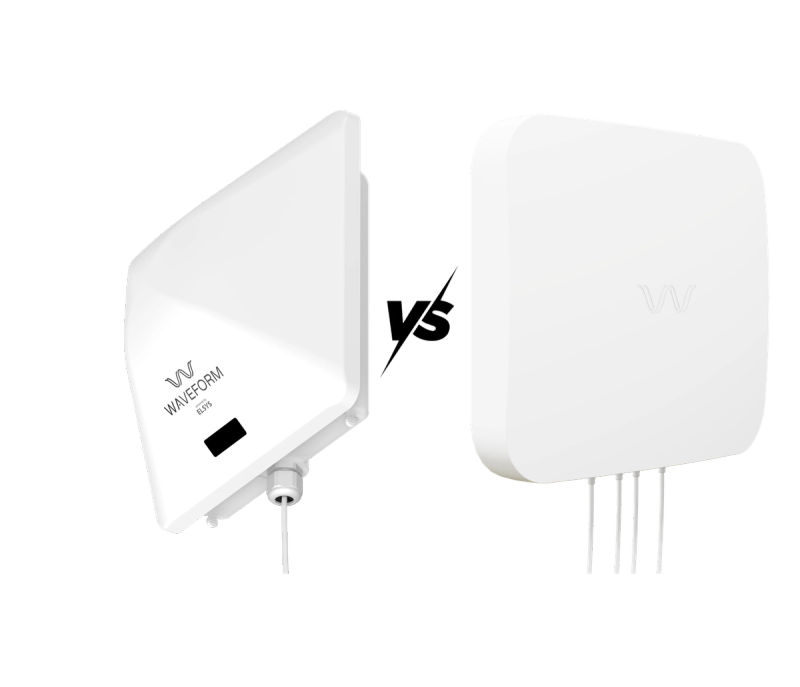
Improving signal is the single biggest way to improve 5G performance, and there are two ways to do it.
External antennas bring a stronger outdoor signal to your indoor modem, while an outdoor modem moves the modem itself outside so it receives that clean signal directly.
Both approaches work. They just shine in different situations.
The Challenge with Indoor-Only Modems
Every 5G modem, whether it sits on a desk or hangs under an eave, works by exchanging radio signals with the nearest cellular tower. Those signals weaken each time they pass through sheet-rock, brick, low-E glass, or even siding. Indoors, the modem must fight its way through one, two, or sometimes five layers of building material before it ever reaches open air.
The result is easy to recognise but hard to predict: one home enjoys flawless 5G speeds at the kitchen table, while a neighbour across the street cannot stream a video in the same spot. The difference is usually not the service plan or the tower, but rather the amount of signal lost on the journey from the tower to the modem’s tiny internal antennas.
Two Ways to Get Stronger Signal
There are two main ways to try to address that loss of signal:
Indoor Modem + External Antennas
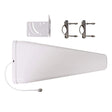
If you already own a good modem that you trust, adding a high-gain MIMO antenna is a solid way to bring the signal indoors. Mount the antenna outside, aim at the tower, and keep the coax run short. With good antennas like the Waveform QuadPro, performance can be excellent.
Outdoor Modem
An outdoor modem skips the coax entirely by taking the whole radio system outside. The modem and antennas sit together in one weather-sealed unit, preserving every decibel of signal and giving the radio direct access to bands that never make it indoors. And because devices like the Waveform ProLink use higher-end modem hardware and carefully matched integrated antennas, they often deliver noticeably faster and more consistent performance than a typical indoor setup.
Why an Outdoor Modem Often Wins
An outdoor modem has a few built-in advantages:
- Cleaner signal from the start.
- Zero loss from coax.
- Full access to mid and high 5G bands (n41, n77, n78) that rarely reach indoors.
- One tidy enclosure instead of multiple boxes and cables.
And because the price typically lands close to the cost of a good modem plus a powerful antenna, the value is easy to see.

Waveform ProLink
ProLink combines a high-end 5G modem, built-in directional antennas, and a weatherproof enclosure in one unit. It avoids coax loss entirely and is designed to take full advantage of mid/high-band 5G. If you want the simplest install with the strongest RF performance, this is the option to consider.
Choosing Between External Antennas and an Outdoor Modem
External antennas and outdoor modems solve the same problem. The decision usually comes down to the install, the hardware you already own, and how much simplicity you want.
When an Outdoor Modem Makes More Sense
- Clean install. One box outside, one Ethernet cable inside.
- No cable loss at all.
- Full access to mid and high 5G bands.
- Stronger modem and antennas than most indoor units.
- Your coax run would be long if you used external antennas.
When External Antennas Are the Better Fit
- You already have a solid 5G modem you want to keep.
- You can keep coax short.
- You prefer the modem staying indoors.
- You’re fine with a slightly more involved install.
The Simple Rule of Thumb
- Outdoor modem: best when you want the strongest, cleanest signal and the simplest install.
- Indoor modem + antennas: best when you already own a good modem and can keep cable runs short.
Both routes solve weak indoor signal. The difference is whether you want the tidiness and upgraded hardware of an outdoor modem, or the flexibility and reuse of your existing equipment.
Conclusion
Walls and windows are the biggest barriers to 5G performance. You can overcome them by mounting high-gain antennas outside and feeding signal to an indoor modem, or by using an outdoor modem that bundles everything into one enclosure.
Both routes work. Both unlock the performance your carrier’s network can provide. The outdoor modem does it with the least signal loss and the cleanest install. External antennas get you close when you already have hardware you want to keep.
Pick the approach that fits your equipment, your installation constraints, and how simple you want the setup to be.
And if you have any questions or want help figuring out which setup fits your home best, reach out to our team.
About the authors
 Marcus Carstens
Marcus is the VP of Product at Waveform, where his team runs Waveform Internet, builds the company's 5G antennas and accessories, manages the third-party products it sells, develops services like plug-and-play private 5G, and writes the documentation that supports it all. He came to connectivity from an unlikely direction, with a degree in biodiversity and ecology, which turns out to be good training for making sense of messy, interconnected systems. He spends most of his time on the parts of a product people feel but rarely think about: whether the connection holds, whether the setup is easy, whether the whole experience earns trust. His approach is craft-first, built on a stubborn belief that getting the small things right is what keeps customers around.
About Waveform
At Waveform we help enable reliable cellular connectivity, everywhere. Trusted by thousands of consumers as well as NASA, Tesla, Stanford, and more. Learn more about Waveform
Suggested articles
See All Guides
InvisaGig 5G Wireless Modem External Antenna Guide
By Afif Chamas · 5 min read
The Definitive Guide to Multi-WAN Internet
By Marcus Carstens · 51 min read