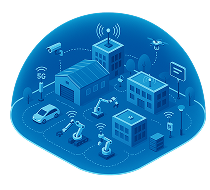
Boston's economy is built on life sciences, higher education, advanced manufacturing, and a rapidly modernizing maritime sector. All of these industries share a need for rock-solid connectivity in environments where WiFi struggles and public cellular is unreliable or too costly. A single biopharma campus in Cambridge or a container yard along the Mystic River can involve millions of data points per hour, mobile equipment, strict security requirements, and harsh New England weather. Those realities make private 5G an increasingly obvious choice.
Why Boston Organizations Are Turning To Private 5G
The Boston metro area packs R&D labs, teaching hospitals, warehouses, sports venues, and Class-A offices into dense city blocks and renovated mill buildings. Each setting brings different wireless pain points.
Life Sciences Laboratories
PCR machines, clean-room tablets, and mobile robots need predictable low-latency links that do not exist on the crowded 2.4 GHz WiFi band or on commercial LTE that routes traffic through distant core networks.
Universities And Campuses
Multi-building campuses such as those in the Longwood Medical Area require outdoor roaming and seamless hand-off. A private network brings the range of macro cellular but retains control inside the university firewall.
Port And Logistics Operations
The Conley Container Terminal and Everett distribution hubs operate acres of outdoor space that is far too costly to blanket with WiFi access points. Two or three CBRS radios can do the work of dozens of WiFi APs at a fraction of the ongoing maintenance effort.
Historic Brick And Stone Buildings
Boston's older construction absorbs high-frequency WiFi signals. CBRS mid-band spectrum used for private 5G penetrates brick more effectively and supports far higher transmit power, extending usable coverage into basements and thick-walled labs.
Add in salt air, nor'easter snow loads on rooftops, and tight local permitting rules and it becomes clear why integrators with deep RF experience are essential.
How Private 5G Outperforms WiFi And Commercial Cellular
Private 5G combines licensed CBRS spectrum with 3GPP standards to deliver carrier-grade performance under the enterprise's direct control.
Capacity and Interference Management
WiFi channels are unlicensed and congested. CBRS operates at up to 47 dBm EIRP, ten to one hundred times the power of WiFi, and is coordinated by the SAS (Spectrum Access System) to prevent interference.
Coverage
One indoor small cell covers 30 000 to 60 000 ft² indoors, while an outdoor radio can serve a 1.5-mile radius. Public carriers would charge per SIM and still might not reach every corner.
Security and QoS
SIM-based authentication eliminates spoofing. The enterprise core enforces QoS slices so voice scanners, AGVs, and security cameras each receive the latency and throughput they require.
For a deeper dive into the technology, visit our detailed Private Networks Guide.
Our End To End Deployment Process
Waveform delivers a turnkey solution so your IT or OT team does not have to become RF experts.
Rapid Site Snapshot
Send us a floor plan or site boundary plus the list of devices you intend to connect. Within a few days we return a radio heatmap, capacity planning notes, and a budgetary range.
Detailed Design
When you are ready to proceed, we complete an on-site or virtual survey, model RF propagation, and produce a proposal with a fixed bill of materials, installation schedule, and acceptance criteria.
Turnkey Deployment
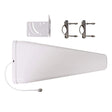
Our installation partners mount small cells, connect fiber or PoE, stage the core, and integrate any edge devices such as Cradlepoint routers or Zebra scanners. We test every area for throughput and latency before hand-off.
Managed Service
We remotely monitor KPIs 24 7 and hold spares for any hardware in the field. An SLA covers firmware updates, spectrum coordination, and on-site support when needed.
Because we remain vendor-neutral, you get the exact mix of radios and core software that matches your requirements. We regularly integrate equipment from Celona, Baicells, Airspan, Peplink, Digi, and Honeywell, selecting the best tool rather than forcing a single brand.
Proven Experience In Massachusetts
Our team has delivered wireless projects across the Commonwealth. Just a few miles from downtown Boston we completed a complex deployment for Bluebird Bio, a leading gene-therapy company. The project required reliable coverage in densely packed lab space with heavy lab equipment and challenging RF reflections. While that engagement focused on indoor mobility rather than a full private network, it demonstrates our ability to meet rigorous biotech standards and local permitting requirements.
What Does A Private 5G Network Cost?
Indoor private 5G deployments in Boston typically fall between $1 and $2.50 per square foot on a turnkey basis, including radios, core software, SIMs, installation, and first-year support. Outdoor sites are even more economical. Covering a 1.5-mile radius yard or campus can often be achieved for around $100 000 depending on topology and existing backhaul. Compared with running fiber to dozens of WiFi APs or paying recurring carrier data fees, the ROI becomes clear in one to three years for most enterprises.
Equipment financing, phased buildouts, and portable "network-in-a-box" kits are all available for events, pop-up labs, or construction sites that need service in days rather than months.
Ready To Talk?
Waveform is the Boston area partner that delivers secure, high-performance private 5G without the complexity. Call us at (800) 637-4049 or get a custom private 5g design and quote today.